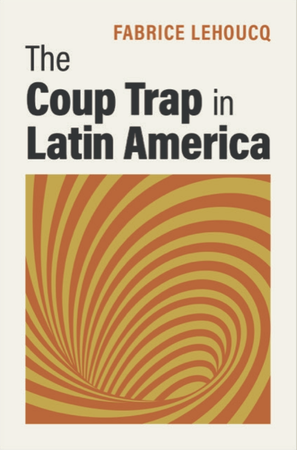
UNC Greensboro’s Department of Political Science will host a public book launch for Dr. Fabrice Lehoucq’s new book, “The Coup Trap in Latin America,” from 5:30 to 7 p.m. Tuesday, Sept. 15, in the Weatherspoon Art Museum Auditorium in conjunction with College of Arts & Sciences Week.
Published by Cambridge University Press in May 2026, “The Coup Trap in Latin America” examines why governments are overthrown, why some political systems become chronically unstable, and how societies can escape cycles of political upheaval. The book draws on more than a century of Latin American history to explore the origins and consequences of military coups, as well as conditions that foster democratic resilience.
While the work focuses on Latin America, its core questions and lessons are applicable to regions around the world.
“Yes, it draws evidence from Latin America, but my book will be of interest to anyone [curious] about how democracies break down — and how to rebuild them in the wake of assaults on their authority,” said Lehoucq.
The launch comes during a period of growing public interest in questions of democratic governance, constitutional stability, and political institutions. Through statistical analysis and historical case studies, “The Coup Trap in Latin America” investigates why some countries become trapped in recurring cycles of instability while others develop durable political systems.
David Holian, associate professor and department head of political science at UNCG highlights some of the major questions of the text that resonate with current political issues.
“Although ‘The Coup Trap in Latin America’ is focused historically and comparatively on Latin America, the questions at the heart of the book have obvious resonance with contemporary American politics: What makes constitutional systems stable? Do political actors continue to regard constitutional procedures as the legitimate way to obtain and exercise power? Under what circumstances do challenges to the constitutional transfer of power become more likely? Why are some democracies able to withstand severe political conflict while others are not?”
The book has already received international attention. Lehoucq has presented research from the project at the T.E. Lawrence Program on Conflict and Political Violence at the University of Oxford, at the 2026 International Congress of the Latin American Studies Association in Paris, and, most recently, at the American Political Science Association (APSA) Annual Meeting in Boston.
In an early review, Steve Levitsky, David Rockefeller Professor of Latin American Studies at Harvard University, praised the book’s contribution to the field.
“’The Coup Trap in Latin America’ brings innovative new methods to an old and important question about dictatorship and democracy in the region. It also provides a compelling new answer. I highly recommend it.”
The book launch on Sept. 15 will feature a discussion by Lehoucq and fellow scholars John D. French, professor of history at Duke University, and Cecilia Martínez-Gallardo, associate professor of political science at UNC Chapel Hill. David McKenzie, assistant professor of public history at UNCG, will moderate the conversation.
The event is free and open to the public.
What: Book Launch for “The Coup Trap in Latin America”
Who: Dr. Fabrice Lehoucq, UNCG Department of Political Science
When: Tuesday, September 15, 2026, 5:30-7 p.m.
Where: Weatherspoon Art Museum Auditorium, UNC Greensboro
Cost: Free and open to the public