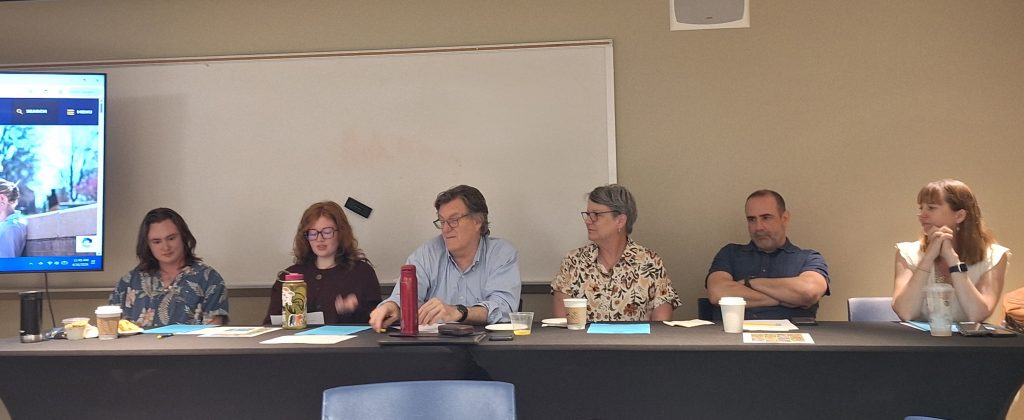
The CAS AI Umbrella launched its inaugural panel presentation, “Tried-and-True New Ideas About Teaching With (And Without) AI,” on April 16, 2026. This panel brought together faculty and students from across the College of Arts & Sciences to share their thoughts on how artificial intelligence is shaping teaching, learning, and academic integrity.
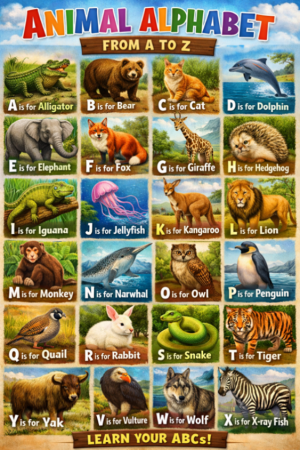
Lydia Fritz, senior lecturer in the Department of Computer Science, brought an AI-produced animal alphabet chart, which was a great illustration of how important it is to double-check the work produced by AI. Fritz also introduced several classroom exercises involving AI to highlight both its pedagogical potential and its limitations.
“AI is already popular among many students at UNCG and beyond,” said Dr. Thomas Jackson, associate professor of history. He noted that AI-generated content can often be detected by recognizing common patterns, but it is still a challenge to document in a way that allows faculty to successfully bring an Academic Integrity case.
Dr. Shaleen Miller, an adjunct faculty member in the Department of Geography, Environment, and Sustainability and Director of Sustainability for the City of Winston-Salem, shared strategies for writing effective prompts for Large Language Models (LLMs) and considered how AI may influence course design. She emphasized that AI use in the workplace is becoming unavoidable and that students need foundational AI literacy to use these tools effectively and responsibly.
Felipe Troncoso, senior lecturer in the Department of Languages, Literatures, and Cultures, presented examples of using AI as a learning tool. Rather than discouraging students from using chatbots, he created AI Agents specifically designed to be used in his courses and gave students assignments that required them to interact with these agents and to reflect on the responses they generated. These type of exercises can help students learn to assess the validity of AI-generated content.
Two students also offered their perspectives on the use of AI in courses. Ricky Crabtree, a philosophy and economics double major with a minor in Ancient Mediterranean studies, and Claire Farmer, a computer science major, described using AI in approved ways to support their coursework.
Both viewed it as a useful reference tool while recognizing its limitations. Although we often talk about faculty concerns about students relying on AI, Crabtree and Farmer stressed that students also have concerns about situations in which faculty leave course design and even grading to AI. They also highlighted the fact that student use of AI is often the result of being pressed for time or feeling unable to provide answers faculty are looking for. Taking such factors into account may reduce student misuse of AI.
Crabtree and Farmer also emphasized the importance of helping students recognize the educational opportunities they gain by completing their own work.
The panel was organized by Dr. Heather Gert, associate professor and head of the Department of Philosophy, who also serves on the CAS AI Umbrella committee.
Written by:
Dr. Bhuwan Thapa, assistant professor in the Department of Geography, Environment, and Sustainability
Dr. Heather Gert, associate professor and head of the Department of Philosophy