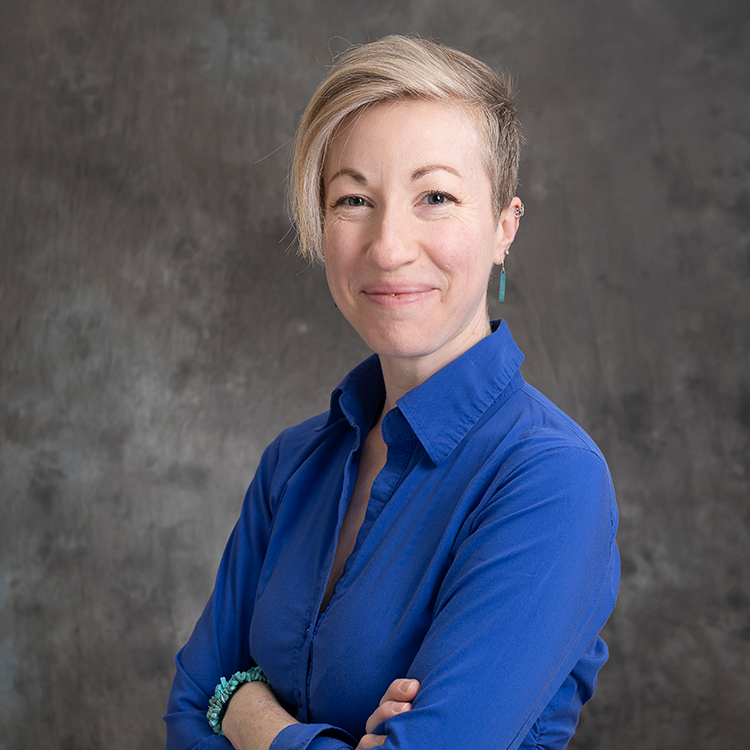
Dr. Ashlee Andrews is an associate professor, head of Religious Studies, and graduate program director for M.A. in Liberal and Interdisciplinary Studies. She is a scholar of religion and ethnographer of contemporary Hindu traditions with expertise in Bengali Hindu traditions as they are practiced in West Bengal, India and the Midwestern United States.
This Q&A with Dr. Andrews discusses her current book project, You Do Not Have To Walk on Your Knees, which utilizes both religious theory and personal memoir to posit a theory of grief and explore the intersections of joy, grief, and community.
Was there a particular starting point or inspiration for writing the book, and what has your writing process been?
The starting point for writing the book was honestly just the death of my husband. As I was sorting through my own experiences of grief, I started – I mean, I’m a scholar and a researcher, so of course I just started researching and reading anything about grief that there was. The neurobiology of grief, what happens in our brains, that’s going to be in the book because it’s really interesting, how literally a person is written into your brain, and when they disappear it takes a long time for your brain to rewire to the reality that they are not walking amongst you. That kind of stuff was sort of helping me to understand why I would want to pick up the phone and text him, even though I know logically he’s not there, and that neurobiology stuff was really helpful.
I also read a book by a scholar named Francis Weller called The Wild Edge of Sorrow that draws in a lot of religious philosophy, especially Buddhist ideas, but this recognition that suffering is a universal human experience, as is therefore grief. Part of his argument is that grief has something to teach us, and we typically want to push it away because it doesn’t feel good. Also, our culture tends to want to ignore the fact of suffering and ignore the facts of death. When we do that, it just sort of turns into a festering wound. When you push something into the darkness instead of bringing it into the light, then it morphs into something negative. His question in the book was, what is the purpose of grief and how can you grieve in such a way where it could even be life-giving?
As I was reading those books, they resonated with me, and they were helping me to understand what was happening inside of me. They were also helping me to…I don’t know, make sense of how I wanted to grieve in a way that felt meaningful.
The last book I read that was sort of urging me, or pushing me, to write my own story and write my own…essentially theory of grief was Joan Didion’s book, The Year of Magical Thinking. She writes this book about her own husband dying, and one of the things that she writes about in the book is that grief to her felt like a kind of madness. She really struggles with the feeling of…just the emotions of it. She’s a very rational thinker and she doesn’t want grief to have control over her in a lot of ways, which I also understood, and anyone who has experienced grief can know that it comes in these waves where you don’t have a lot of control over them.
So, the process of writing the book has been about trying to think about all of those things together. Religious traditions talk a lot about suffering; they talk a lot about how to navigate suffering, how to make meaning from it, how it’s related to joy. But scholars haven’t written a lot about if religious traditions have a kind of theory of grief. Like, how do religious traditions tend to approach what grief is and what its function is? But they have a lot of wisdom about suffering and grief, too.
Essentially, You Don’t Have to Walk on Your Knees is part memoir, part my own experiences of grief, and it’s partially about how these nonreligious sources helped me understand grief. Then it’s also looking at how religious traditions and their wisdoms have provided a way of understanding and making my way through grief.
Was there anything that had to be changed or reworked from an initial assumption that you had?
I think because the book has so much personal experience, the thing that comes up a lot is that as I’m writing, the way that I was thinking about grief can change very quickly.
If there are assumptions that change a lot, they’re about my own understanding and my own process of grief. Like, that grief is always evolving, and it evolves as I think with sources, but also as I listen to the people around me who are grieving and who have lost. In a lot of ways what the book is chronicling is what I have learned about grief.
I guess that’s why I was struggling to answer the question, because there are just so many ways of thinking that I have changed in the process of writing it, and in a lot of ways in the process of opening myself up to grief. I think that’s why I like the Francis Weller book that I had mentioned earlier. He says that grief has something to teach you. So, I’m learning a lot from grief, too.
The title of the book, You Do Not Have to Walk on Your Knees, where does that come from?
It comes from a Mary Oliver poem called Wild Geese. I love that poem. Essentially I think it’s a poem against shame. It’s against shame of any kind, but I think especially this sense that we are not good, which is why the beginning of the poem is, “you do not have to be good, you do not have to walk on your knees for a hundred miles through the desert.”
She goes on to say, you just have to love what the soft animal of your body loves. The reason that I love that idea, you don’t have to walk on your knees, is because I think that it has two meanings.
One is that suffering and grief, they sound like walking on your knees through the desert for a hundred miles and sometimes they do feel like that. But, at the same time, there are ways of making your way through the desert, I guess. There are gifts that come to you that you think are a mirage, but they’re true and real. For example, as I was suffering, as I was grieving, I also experienced some of the most beautiful expressions of human love and compassion that I would only have known, and I only know because I suffered and because I grieved.
I had a community of friends that surrounded me. As one little example, my dear friend and her husband decided to pay for my youngest child’s childcare until she got to kindergarten, because we lost my husband’s salary and we were going to struggle to pay for her childcare. They just stepped in and offered it. Just all kinds of little things like that, where the goodness of people, the love of people, I only came to know because of their compassion and empathy and their recognition that what I’m suffering is something that they will suffer eventually, or maybe they have suffered. Those are the sort of gifts of those times of struggle. It’s hard because suffering hurts and you’re deep in it, but you have to stop and witness the goodness that’s in it as well. If you can, then that is the gift that comes from grief and suffering.
That’s one meaning of that title, and the other meaning of the title is really about how my own husband died. He died of bipolar disorder and just carried a lot of shame that I think ultimately informed his idea that the world was better off without him. So, it’s also sort of another way of saying that rather than carrying shame, rather than thinking that the world is better off without you, know that you just have to love what you love and that that is the most beautiful thing that we are called to do. He did it well, and if he had seen that instead of carrying the shame, then he might still be alive today.
That’s another objective of the book. It’s a testament to human love as well as the love that I experienced when people carried me through my grief. I became aware of that love because of that grief, but I also became aware of the fact that the cost of love is grief.
To end on a fun question, is there an album or was there a soundtrack for writing this book?
Absolutely. There are two that come to mind. The first is Sufjan Stevens’ album Carrie & Lowell. He wrote that album about his process of grieving his mother, who also died of a mental illness, and really the complexity that grief can have.
The other album is by an artist named Lucy Dacus, her album Forever is a Feeling. She’s not chronicling grief; she’s actually chronicling love in all of its sometimes painful forms.
I’m still writing the book, and the newest album that I love and that is getting me through the writing is Phoebe Bridgers’ new album called Lost Weekend. It is about her journey of grief after losing her father as she’s falling in love with her new partner.
Dr. Andrews is continuing to work on the manuscript for You Do Not Have To Walk on Your Knees. She looks forward to the finished work helping others in their understanding and processing of grief.
Interview by Milo Green, Humanities at Work intern