CAS Research POLICIES
1.Research Assignments & Fellowships
1. What assignments for research and scholarship are available to me before tenure?
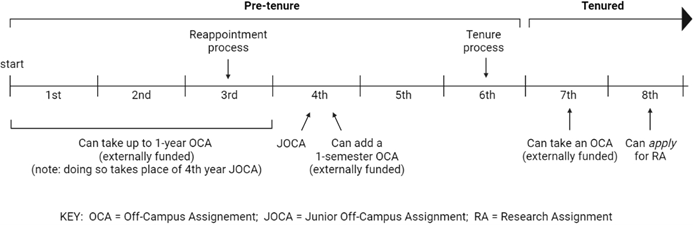
If you are an Assistant Professor, you will be awarded a one-semester assignment for research (the Junior Off-Campus Assignment) after reappointment to a second term. See CAS JOCAs Policy.
You may also request an Off-Campus Assignment if you are awarded an external fellowship (subject to restrictions explained in the College’s policy on external fellowships). See CAS Fellowships Policy
2. Why should I apply for fellowships in my first three years if I can expect a Junior Off-Campus Assignment anyway?
Such awards are prestigious and contribute importantly to your professional reputation and the strength of your tenure dossier, and because all faculty members have an obligation to seek external support for their scholarship, regardless of the internal support that may also be available. Such external awards will also increase your competitiveness for future awards far more than an internal award can.
3. What is the difference between an Off-Campus Assignment, a Junior Off-Campus Assignment, and a Research Assignment?
An Off-Campus Assignment for research provides release from teaching and service in order for you to accept an external fellowship award. The funding agency must require that this release be provided as a condition of the award – an Off-Campus Assignment cannot be requested simply because you receive external funding. The College will match the value of the award, up to a maximum of 50% of your 9-month salary. See CAS Fellowships Policy.
- A JOCA provides a one-semester release from teaching and service at full salary, contingent on an acceptable work plan and approval of department head, after reappointment to a second probationary term. It is not competitive. See CAS JOCAs Policy
- University Research Assignments are awarded competitively to tenured faculty and provide release from teaching and service for one semester at full salary or one academic year at half salary, contingent on the recommendation of the Research Assignment Committee and the approval of the Dean and Provost. A tenured faculty member is eligible for a research assignment every five years. See CAS Research Assignments Policy.
4. What is the difference between an Off-Campus Assignment in the case of a fellowship, and a course buy-out in the case of a grant?
Fellowships generally require that the recipient have no institutional responsibilities while on the fellowship. Thus, a fellowship holder is given an Off-Campus Assignment for research. A grant does not normally require complete reassignment of duties but may provide funds that allow for buyout of courses, freeing up some additional time for research. For Course Buyout information, see CAS Course Buyout Policy
5. What are the expectations regarding time back on campus after a research assignment or off-campus assignment?
You are expected to return to your position at UNCG for at least twice the length of time for which you were on assignment, i.e., for one year after a one-semester assignment and for two years after a one-year assignment (this expectation does not apply if you have taken a Leave without Pay).
6. What is the maximum time I can be on an Off-Campus Assignment or Research Assignment?
Normally, Assignments are limited to one year; under exceptional circumstances, this may be extended. If you want to request an Off-Campus Assignment for longer than one year, you must discuss it with your department head/program director as well as the Dean before making any plans (but please know that this is discouraged). See CAS Research Assignments Policy.
7. Why must I get Department Head/Program Director approval for a course buyout in a grant proposal?
Department heads/Program Directors need to be sure that the buyout you are requesting can be accommodated and will need to incorporate the possibility that the grant will be awarded into schedule planning for the affected semesters. For more info on course buyouts, see CAS Course Buyout Policy.
8. What is the maximum salary I can expect from UNCG if a fellowship pays less than full salary?
The College’s policy is to match the salary provided by an external fellowship up to a maximum of 50% of your base salary for the period of the award. If the total amount of the fellowship is less than 50% of your base salary, the College will match only the amount of the fellowship, meaning that your total salary for the year will be reduced. The matching funds are contingent upon the availability of CAS funds.
Some fellowships provide relatively low levels of financial support. In general, it is expected that such fellowships will be combined with other awards, such as a University Research Assignment rather than being used alone to fully support a leave. Thus, you are advised to begin planning well in advance of the application due date and have a well-developed budget.
9. Why must I submit a Fellowship Notification Form, and submit my fellowship proposal through Cayuse, if the funding agency allows me to apply directly to them?
The Fellowship Notification Form (found here) certifies that the department will be able to cover your absence with the funds available if the fellowship is awarded. This form should be submitted as soon as you decide to apply for a fellowship. Approval of the proposal itself, via Cayuse, ensures that all requirements of the funding agency can be satisfied and also ensures that you, your department, the College, and UNCG are credited for the fellowship submission.
If you fail to submit the Fellowship Notification Form, or route the fellowship proposal through Cayuse, then the College is under no obligation to provide any support if the fellowship is awarded. In that case you could request a leave without pay if you wish to accept the award.
10. Why must I have all aspects of a proposal finalized in Cayuse at least 5 days before the agency deadline?
The Office of Sponsored Programs needs at least five working days to process all proposals that UNCG must submit online on your behalf to ensure that there are no errors. Even the smallest error might cause the agency to reject the application, and it is not unusual for a proposal to be rejected several times before all errors are corrected. This also allows time to get all appropriate proposal approvals and to deal with possible technical issues on UNCG’s end or on the agency’s end.
11. What should I do if my grant or fellowship is not fully funded?
It is not uncommon for grants and fellowships to be funded at a level below that requested. In such instances, for grants, it is your responsibility to restructure the scope of the work to match the budget available. The university cannot supplement the unfunded portion of your project. It is advised that you work in concert with the program officer at the funding agency, as well as with UNCG Office of Contracts & Grants, as you revise your workplan and budget. For fellowships, it is your responsibility to ensure that your salary will be adequate. Policy permits the university salary match to be equivalent only to salary award received from the fellowship up to 50% of your salary. A fellowship award of less than the requested/needed amount needs to be discussed with the department head and dean before accepting the fellowship.
12. I completed a University Research Assignment less than three years ago. May I apply for a fellowship and receive CAS financial support?
You may apply for a fellowship. However, faculty are not normally eligible to receive a CAS-supported off-campus assignment and supplemental salary support for a fellowship until three years have elapsed since their most recent Research Assignment or fellowship-supported off-campus assignment.
Exceptions are not automatic and should be discussed in advance with the Department Head/Program Director and the Associate Dean for Research.
13. What if the funding agency pays the fellowship directly to me rather than to UNCG?
Whenever possible, fellowship funds should be paid to UNCG. If the agency does not permit this arrangement, you must accept a partial salary from UNCG and receive the fellowship payment directly from the agency. You are responsible for arranging benefits coverage with HRS and paying any required taxes.
14. I am professional-track faculty. May I receive CAS salary support for a fellowship?
Professional-track faculty and instructors are not eligible for CAS supplementary salary support. They may be granted an off-campus assignment if they receive a fellowship, but the fellowship must cover all salary and benefits for the assignment period.
15. What if my fellowship does not require a full release from teaching and service?
An off-campus assignment is appropriate only when the funding agency requires a full release as a condition of the fellowship. If external funding supports only part of your effort, a course buyout may be more appropriate. Consult your Department Head/Program Director and the CAS Office of Research before applying.
Typical timeline (in years):