Documentary Film and Talk: “Wilmington on Fire” and the Power of Public Memory
September 14 @ 12:00 pm – 2:00 pm
As part of College of Arts & Sciences Week 2026, Our Cinematheque welcomes acclaimed North Carolina filmmaker Christopher Everett for a special screening and conversation exploring the intersections of history, race, memory, and social justice as portrayed in his film “Wilmington on Fire“.
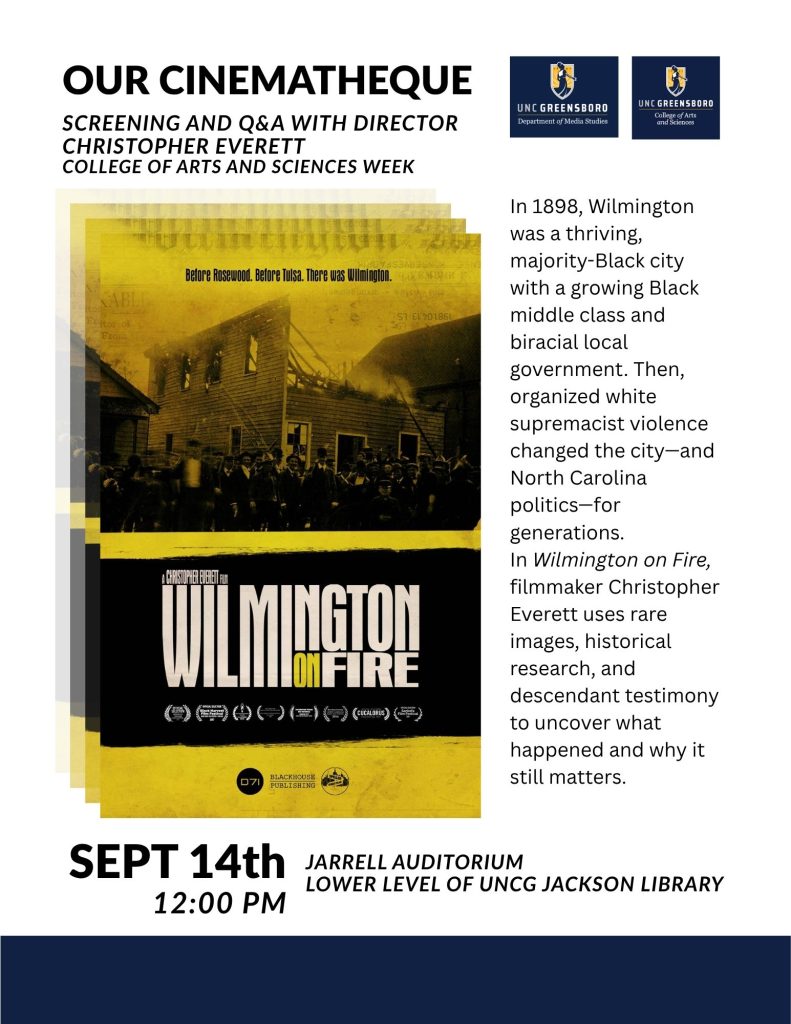
Everett’s groundbreaking documentary brought national attention to the 1898 Wilmington Massacre—the only successful coup d’état in United States history—and its enduring impact on democracy, race relations, and historical memory.
The screening will be followed by a moderated conversation and audience Q&A with the filmmaker, inviting students, faculty, and community members to consider how documentary filmmaking can illuminate the past while shaping conversations about the future.
In this exclusive College of Arts & Sciences Week event, Everett will discuss the continuing relevance of this history and share an advance work-in-progress cut from the forthcoming next chapter of the Wilmington on Fire project, offering audiences a rare opportunity to engage with new material before its official release. Building on the original film and subsequent chapters, the new work examines contemporary struggles for historical justice, community empowerment, and the ongoing effort to reclaim overlooked histories.
Free and open to the public.
About the film
The film documents the violent overthrow of Wilmington’s multiracial government and the destruction of a thriving Black community, a history long omitted from mainstream narratives: The Wilmington Massacre of 1898 was a bloody attack on the African-American community by a heavily armed white mob with the support of the North Carolina Democratic Party on November 10, 1898 in the port city of Wilmington, North Carolina. This incident has been barely mentioned and omitted from most history books. It was not until 2006, after the North Carolina General Assembly published a report on it, that the tragedy became known to the general public.