“Microplastics have been found… I mean, everywhere. Soil, air, water — it’s everywhere,” says Christopher Pilgrim, a junior biology major and Munroe Research Award recipient.
“And this is the thing that really captivates me: it doesn’t matter your demographic or socioeconomic status. This is affecting everybody.”
Pilgrim says the danger of microplastics in the environment might be easy for people to overlook. After all, some microplastics – called nanoplastics – are smaller than 1 micrometer and invisible to the naked eye.
Before he became an undergraduate researcher in Dr. Zhenquan Jia’s molecular toxicology lab, Pilgrim had heard of microplastics, but he was surprised when he learned the scale of the problem.
“I got to admit, I knew it existed, but I didn’t realize, you know, the extent of it until I began researching it.”
He knows a lot more now.
Pilgrim has been researching the effects of microplastics and nanoplastics (MNPLs) on cellular DNA. Previous research from the Jia lab has shown the harmful effects of MNPLs on bodily organs and tissues, but the underlying mechanism of harm still is not clear. Scientists know that MNPLs can induce the production of reactive oxygen species (ROS) in cell culture models. These rogue oxygen molecules – a type of “free radical” – can damage cellular structures, including DNA.
Pilgrim designed an experiment to see if MNPLs would induce DNA strand breaks. The Munroe Student Research Award provided funds to purchase supplies for his initial experiments. Using bacterial plasmid DNA and MNPLs of 0.7 micrometers, Pilgrim conducted a series of tests where he varied the concentration of MNPLs relative to plasmid cells and the amount of time the two were incubated. He expected the double-stranded, circular DNA of the plasmid would be broken or split when exposed to the MNPLs.
But those early tests did not confirm his hypothesis. Pilgrim wondered if the synthetically produced microplastics he used, with their smooth edges and relatively pure chemical composition, were simply less damaging to DNA. Microplastics found in the environment are jagged and misshapen, and they can bind with other chemical groups, like chlorides, to become potentially more toxic. He also suspected bacterial DNA may not be a “physiologically relevant model,” since “there are a lot of natural differences between a plasmid DNA in vitro and a cellular environment” in the human body.
With Dr. Jia’s encouragement, Pilgrim applied for funding from the Undergraduate Research, Scholarship, and Creativity Office (URSCO). Using the new funding, he purchased more lab supplies and ran new experiments under different conditions.
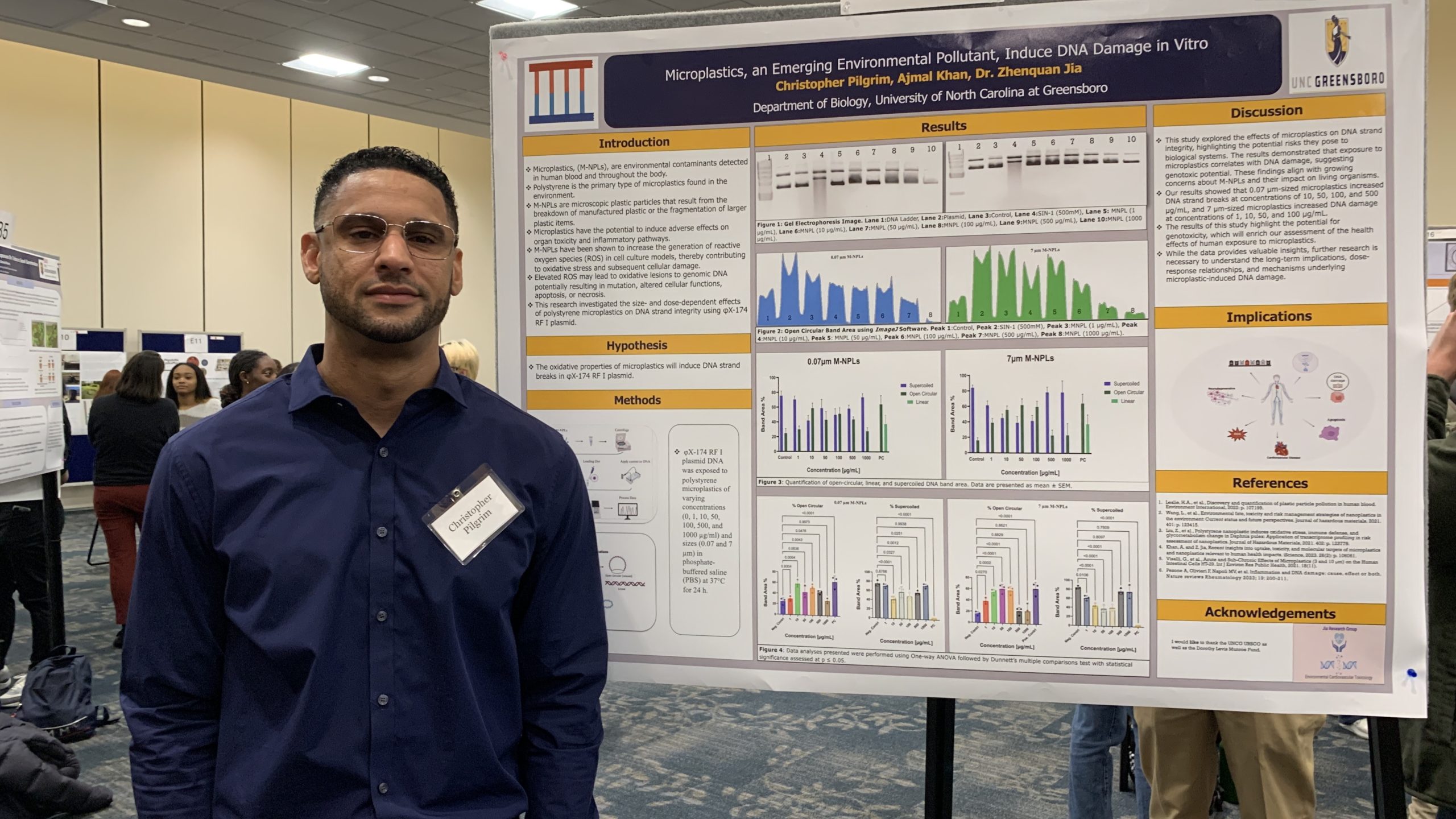
Pilgrim found the MNPLs did damage the plasmid DNA when he increased the size and concentration of the particles and extended the incubation time. He shared these results in a poster presentation at the Thomas Undergrad Research & Creativity Expo.
Pilgrim’s journey to becoming a biology major at UNCG was also a process of experimentation.
The Texas native got his first degree in business from a college in Tennessee and went into the workforce. He was doing well, though a bit bored with his routine, when the COVID pandemic hit. Realizing what he calls “the fragility of things,” he decided to make a change.
A life-long musician, Pilgrim enrolled at UNCG planning to major in psychology and become a music therapist, but an introductory biology course was “an epiphany” for him. He changed his major to biology, began work in Dr. David Remington’s lab, and eventually wound up in a biotechnology section taught by Ajmal Khan, a PhD student in Dr. Jia’s lab.
“I was just taken aback,” says Pilgrim “Once again, it hit me. Another epiphany.” He was inspired to understand the mechanisms of diseases and make discoveries that could help improve people’s lives.
Plus, he appreciates the challenge. “I just like to be stumped by something and try to solve it. I’ve found that within this field.”
The Dorothy Levis Munroe Research Fund was endowed by alumna Dorothy Levis Munroe ‘44 to support student research in the “natural and mathematical sciences.”