
Beginning January 25, 2025, several important changes to the NIH fellowship application will go into effect. These changes, and the rationale behind them, were discussed in a recent NIH webinar. This posts shares background and key takeaways from that session. In theory, these changes should improve chances for fellowship applicants from institutions like UNCG.
The upcoming changes are the result of an extensive NIH review of its fellowship application and selection process. This review, which began in September 2021 with the formation of an NIH working group, was prompted by concerns about selection biases favoring elite schools and well-known scientists, and disadvantaging applicants from other educational backgrounds. The working group gathered public comments, input from NIH officials, and other data in its effort to understand and improve the process.
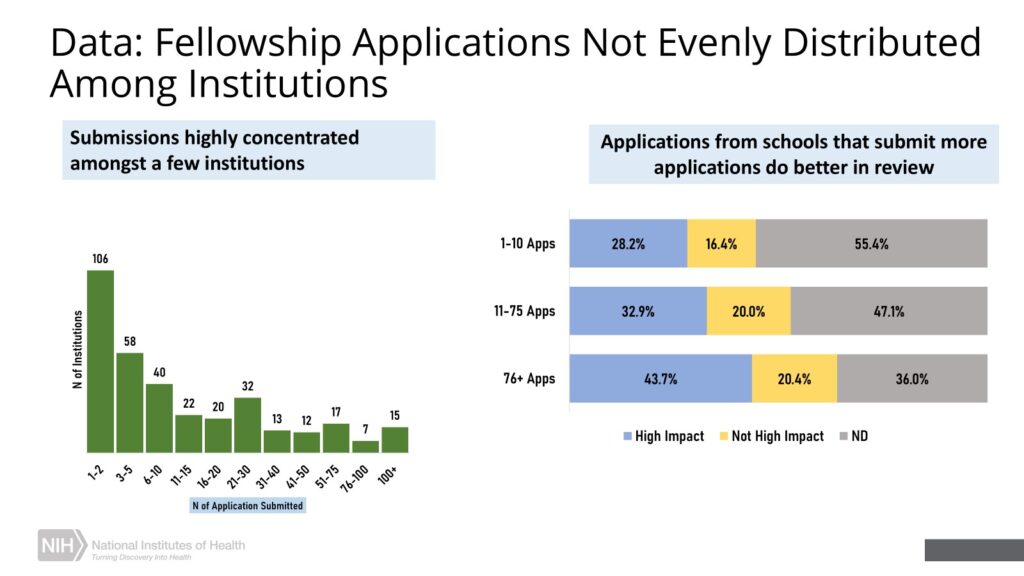
The working group found large, elite institutions do have an advantage. The graphs below were presented during the webinar, and both depict NIH fellowship application data from 2021. The graph on the left shows the number of institutions submitting particular quantities of applications. At one extreme, 15 institutions submitted more than 100 fellowship applications each, while at the other, more than 100 schools submitted just one or two. The graph on the right shows how applications from high-volume schools do much better in review, with more than 43% of applications from high-volume schools being rated as high-impact, compared to just 28% of applications from low-volume schools.
The working group issued a final report that included recommendations to remedy these and other concerns. Then, NIH conducted a two-year process to implement the group’s recommendations by revising fellowship policies, processes, and application materials. Some of the resulting changes are:
- Simplified and clarified review criteria: fellowship applications will be reviewed using 3 criteria — 1. Candidate Preparedness and Potential, 2. Research Training Plan, and 3. Commitment to Candidate — rather than 5 criteria as before.
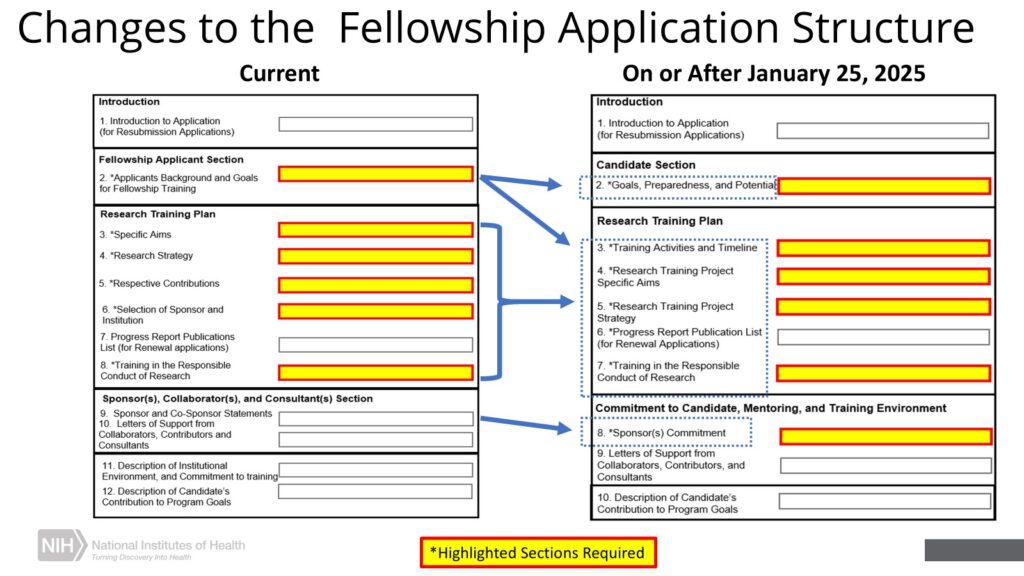
- Simplified and revised the application: shorter; emphasis on project as a “research training project” focused on the training potential of the research; less emphasis on track record of the faculty sponsor and more emphasis on training plan; sections that focus on the faculty sponsor and institutional environment are now framed in terms of contribution to candidate’s training; clarified who should author each section.
- Eliminates the requirement to submit grades!
- Updated and clarified Reference Letter instructions, coming later this year. The process for submitting Reference Letters remains the same.
The slide below illustrates how the application has been reorganized and streamlined. Learn more about these changes here.
The ultimate goal of these changes is to improve the chances that the most promising fellowship candidates will be consistently identified. These changes apply to all the NIH F-series fellowships, including predoc (F30 & F31), postdoc (F32), senior fellows (F33), and pre-to-post-doc fellows (F99/K00). More info and resources are available at the NIH website Revisions to the NIH Fellowship Application and Review Process.