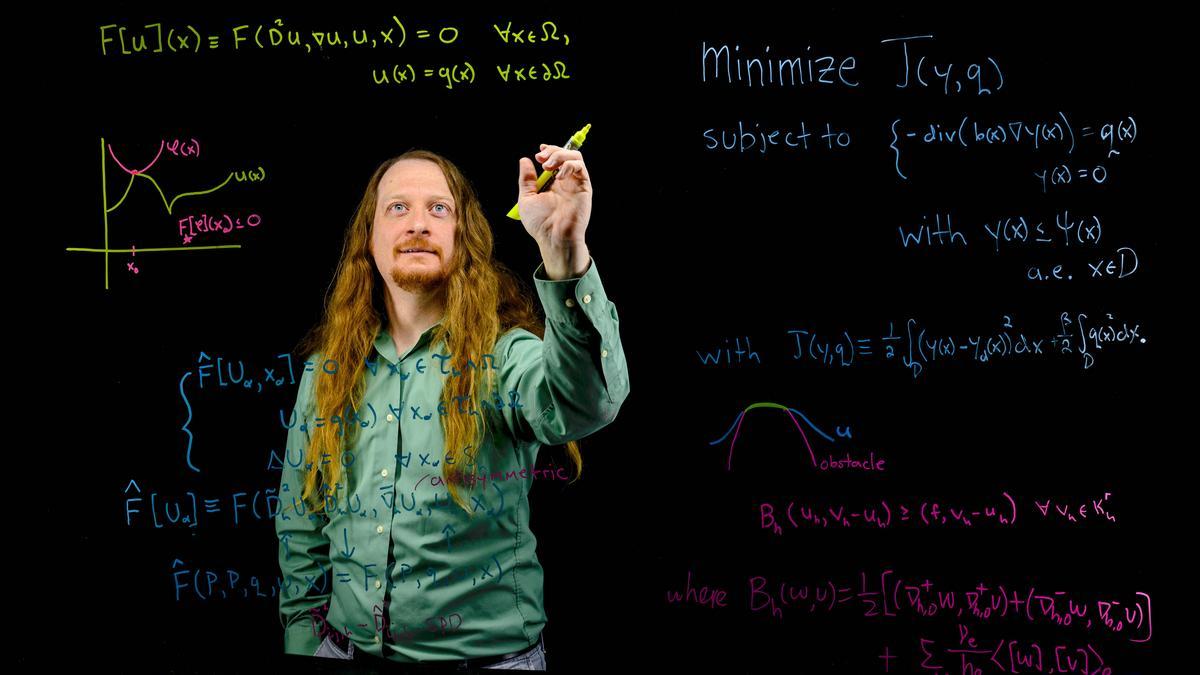
Dr. Tom Lewis, Professor of Mathematics and Statistics, has received a new three-year grant from the American Mathematical Society for his project, Narrow-Stencil High-Order Numerical Methods for Approximating Nonlinear Elliptic PDEs. The funding will support travel and supplies to enhance Dr. Lewis’s research, to support his mentoring of graduate students, and to develop undergraduate research opportunities.
Dr. Lewis was featured in a 2022 article in the UNCG Research Magazine.
The abstract of his new project provides more info:
Abstract:
The goal for this proposal is to formulate and analyze various narrow-stencil numerical approximation methods for approximating viscosity solutions of fully nonlinear elliptic partial differential equations (PDEs). Fully nonlinear second order PDEs have applications in many fields such as astrophysics, differential geometry, fluid mechanics, image processing, stochastic optimal control, etc. Narrow-stencil methods preserve the local nature of a PDE when forming the discretization while utilizing stabilization in lieu of monotonicity properties to ensure stability and convergence. As such, the methods yield sparse algebraic systems and are straightforward to formulate and to implement. The primary emphasis will be on extending the recent works of the PI for formulating and analyzing narrow-stencil finite difference and discontinuous Galerkin methods for approximating uniformly elliptic problems and Hamilton-Jacobi problems to the second order degenerate elliptic case with an emphasis on the Monge-Ampere operator and the Hamilton-Jacobi-Bellman operator.
The motivation for the new analytic techniques will be discrete analogues for various sub- and super-solution techniques at the PDE level for nonlinear reaction diffusion equations as a way to bypass stronger properties such as a maximum principle or a comparison principle. The new framework will allow for broader applications of narrow-stencil techniques since it will specify simple criteria that a scheme can satisfy in order to guarantee admissibility, stability, and convergence without relying upon monotonicity, uniform ellipticity, or a comparison principle. In contrast to the previous results for narrow-stencil methods, the updated tools should allow for non-uniform meshes that are suitable for adaptivity while providing more insight into the essential aspects of discretizing fully nonlinear elliptic PDEs.
A secondary focus in this proposal is formulating and analyzing new ways to reliably approximate and find all positive solutions to nonlinear reaction diffusion problems that arise in applications such as mathematical ecology and combustion theory. Many such problems have multiple solutions or no positive solutions making it difficult to guarantee that the approximation method does not converge to an algebraic artifact. This focus for the project will be highly collaborative with various mathematicians that specialize in the PDE analysis of nonlinear reaction diffusion equations.
The PI specializes in nonlinear analysis techniques for numerical methods, and his research group specialize in nonlinear analysis for elliptic PDEs allowing for meaningful collaborations that inspire new analytic tools for the numerical analysis of narrow-stencil methods for reliably approximating nonlinear elliptic problems coming from a wide range of applications.