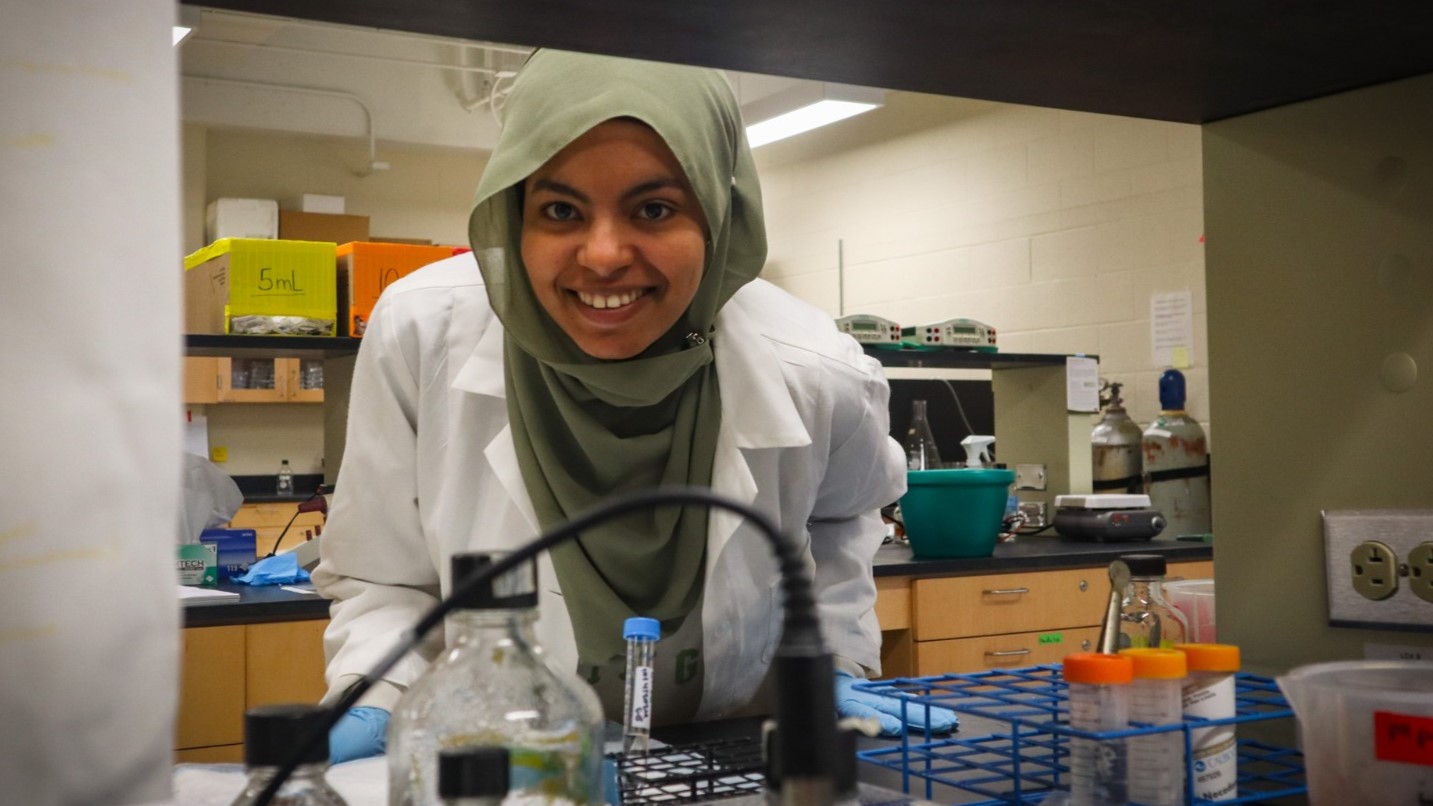
Fatima Elhorry has loved being in the lab from the very beginning.
The junior biology major and Dorothy Levis Munroe Student Research Award recipient grew up in Malaysia, where her father was completing his first PhD. As a child, she tagged along when he went to the lab.
“I would just love looking in the microscopes, and I remember one time he showed me how to use nitrogen. It was really fun. Me and my dad bonded over science.”
After coming to Greensboro, Elhorry took a chemistry class at Grimsley High School. It was a chance for her to do science herself.
“I was surprised that we had to do an experiment from scratch, and I really, really enjoyed that. I remember talking with my dad about it. He even came to my school one time just to see what I was doing.”
When she arrived at UNCG, she sought out opportunities for undergraduate research. As a sophomore, she connected with Dr. Yashomati Patel, professor of biology, and she joined the lab as an undergraduate researcher.
Elhorry initially worked on experiments to investigate the effect of naringenin (Nar), a natural compound found in grapefruit, on breast cancer cells. But her recent research, supported by the Dorothy Levis Munroe Student Research Fund, looks at the effect of naringenin on cells called adipocytes.
Adipocytes are lipid cells, or fat cells, that regulate the amount of glucose in the blood. Responding to the hormone insulin, adipocytes draw glucose out of the blood stream and store it as fat. But excess glucose can lead to excess fat storage and eventually obesity. As adipocyte cells become larger and more numerous, they become resistant to insulin, which means they no longer function to remove excess glucose from the blood. This can cause hyperglycemia, or high blood sugar, a dangerous condition associated with diabetes.
Researchers in the Patel lab had discovered that treating adipocytes with naringenin resulted in reduced lipid accumulation over time. In other words, Nar kept fat cells from getting too fat. The next question was whether Nar helped adipocytes retain their sensitivity to insulin. Elhorry has been working to answer this question.

She used her $1000 Munroe Student Research Award to purchase glucose uptake assay kits so she could analyze the amount of glucose taken up by the adipocytes across the various treatment conditions. Her findings are promising.
“By treating the cells with naringenin we are actually able to see that we aren’t losing the insulin sensitivity. We are able to take up more glucose. And we are seeing less accumulation of lipids, by about 20 percent. So that is a very good sign.”
The adipocytes cells Elhorry works with are from mice, but she says the cells are quite similar to the lipid cells found in the human body.
While there are existing treatments for both diabetes and obesity, those treatments can have negative side effects and may not be effective for everyone. Naringenin could become the basis for an alternative treatment, but more research is needed.
Despite her early encounters with science, Elhorry had much to learn about working in a cell biology lab. She says Cynthia Porter, a PhD student in Patel’s lab, has been a great mentor to her. Porter is also researching the effects of naringenin on lipid cells, so their work overlaps.
“She knows how to explain things and break them down into simple steps. I’m always asking her questions, coming to her with any findings I have, anything weird that’s going on — I’m always talking to her about it.”
One of Elhorry’s favorite things about being a student at UNCG — besides the meditation room in the EUC, the Muslim Students Association, and SGA — is grabbing a coffee on Tate Street with Porter.
Next semester, Elhorry will continue working in Patel’s lab before graduating in December. After that, she’s thinking of going to medical school or pursuing a PhD or perhaps both. She is grateful for the research experiences and mentorship she has had at UNCG.
“There are definitely lessons I’ve learned,” she says. “One is to be patient. Not everything is going to come out perfect, or if it does come out, it will only be half-way there. You’ve got to be patient to go back and learn what happened … Another thing is to come in blind when you start your research. You might think you know something, but it turns out you don’t. That’s the beauty of research. You are going in blind and you’re looking and trying to find an answer.”

The Dorothy Levis Munroe Research Fund was endowed by alumna Dorothy Levis Munroe ‘44 to support student research in the “natural and mathematical sciences.”
Featured photo by Zainab Adamou-Mohamed.